Customer: Optonic GmbH
Optonic GmbH develops machine vision and automation solutions for customers in industries including electronics, automotive, medical technology, logistics, and mechanical engineering. With more than 30 years of experience, the company specializes in industrial imaging, robotic guidance, and custom vision systems.
For one customer in the furniture industry, Optonic was tasked with solving a particularly demanding automation challenge.
Industry: Industrial machine vision and automation
Application: Automated identification of furniture panels for robotic handling
When a conventional scanning approach proved unable to meet demanding performance requirements, Optonic turned to Optotune’s steering mirror and liquid lens technology to deliver a successful automation solution.
Customer challenge
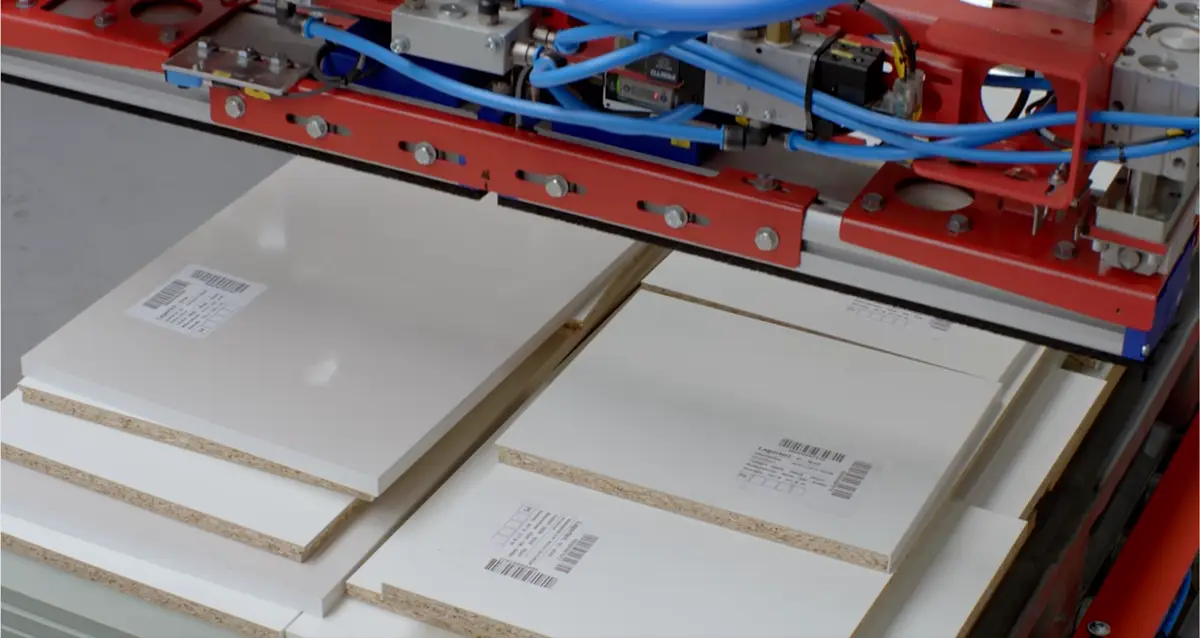
The end customer needed to automate the handling of furniture panels stacked on pallets. Before a robot could pick and load a panel into a production machine, the system first had to identify the panel using information stored in barcode labels.
Several factors made the application difficult:
- A large working volume of approximately 1500 × 1200 × 1000 mm
- Randomly positioned panels and labels
- Up to three barcodes to read per panel
- Only three seconds available for the entire identification process
- An industrial production environment requiring high reliability
The barcode-reading subsystem was a critical component of the overall automation project. Without a reliable solution, the complete system could not be successfully delivered.
The roadblock – when the original approach fell short
Optonic initially pursued a solution based on galvo-scanner technology. During testing, however, the available mirror movement range proved insufficient for the required workspace.
At this point the project faced considerable pressure. Delivery deadlines had already been established and the system had been sold to the customer. Optonic needed an alternative capable of meeting both the performance requirements and the implementation timeline.
Alternative approaches involving multiple high-resolution cameras were considered but would have increased system complexity, calibration effort, maintenance requirements, and hardware costs.
The solution
Having worked with Optotune before, Optonic explored whether adaptive optics could provide a more flexible solution. Following discussions and evaluation testing, Optonic selected:
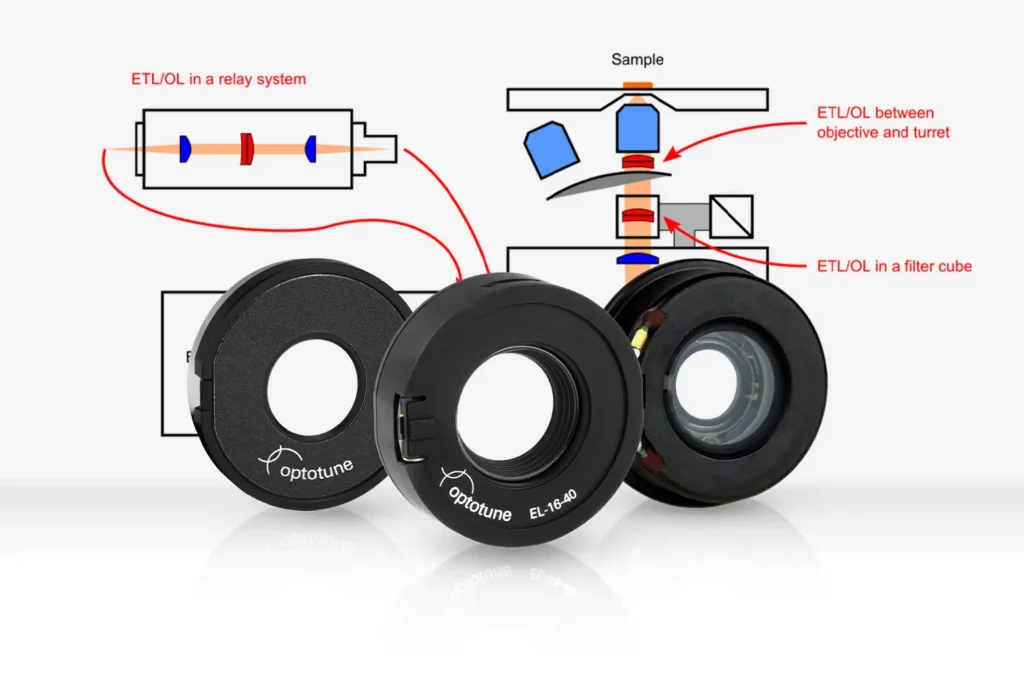
EL-16 liquid lens
The EL-16 liquid lens enabled rapid electronic focus adjustment across changing object distances, helping maintain image sharpness without mechanical movement.
MR-15-30 steering mirror
The MR-15-30 steering mirror allowed the system to rapidly redirect the optical path to different regions of the workspace. According to Optonic, the mirror’s speed, flexibility, and compact size were among the key factors that made the solution viable for the application.
Why this combination worked
Together, the liquid lens and steering mirror enabled Optonic to create an Area Barcode Scanner capable of acquiring sharp images at freely selectable three-dimensional positions. Compared with alternative approaches based on multiple high-resolution cameras, the solution offered a more compact architecture with reduced complexity while maintaining the required performance.
Why Optotune
Optonic highlights that the project’s success was not only based on product performance. The team cites several factors that accelerated deployment:
- Rapid access to application expertise
- Fast availability of evaluation hardware
- Practical integration support
- On-site discussions to evaluate possible solutions
- Collaborative engineering mindset between both teams
These factors helped Optonic quickly validate the concept and move forward with implementation when time was critical.
“When our original solution approach reached its limits, we needed an alternative quickly. The combination of innovative technology, fast evaluation support, and close collaboration helped us successfully deliver the project.”
– Detlef Reising
Results
By combining its vision expertise with Optotune’s steering mirror and liquid lens technology, Optonic was able to overcome a challenge that had threatened the success of the entire project. What began as a limitation of the originally selected scanning technology ultimately became an opportunity to develop a more capable and flexible solution.
Meeting the performance requirements
The completed Area Barcode Scanner enabled Optonic to reliably identify furniture panels across a large three-dimensional workspace while operating within the strict timing constraints of the application. The system could rapidly locate barcode labels, acquire sharp images at different working distances, and support the robotic handling process required by the end customer.
Simplifying the system architecture
Rather than relying on multiple high-resolution cameras to cover the inspection area, Optonic achieved the required coverage using a compact optical architecture based on adaptive optics. This allowed the team to avoid the additional complexity associated with multi-camera setups, including increased calibration effort, larger data volumes, and higher maintenance requirements.
Delivering the customer’s project
Most importantly, Optonic was able to successfully deliver a system that fulfilled a critical role in the customer’s automation process. According to the company, the final solution not only met the original requirements but exceeded them, helping transform what had become a significant technical risk into a successful production-ready application.
See more about the products
Keep up with the latest in tunable optics
Get new blog articles, application examples, industry trends, and product updates delivered straight to your inbox.