
High native resolution can be costly, in particular when pixels need to be large. This holds true for DMD and micro-LED displays or thermal and high-sensitivity CCD or CMOS sensors.
Optotune’s pixel shifters are an affordable and reliable way to quadruple the resolution. Only a few millimeters thin, they can be placed between the display/sensor and the projection/imaging optics.
- Compact, lightweight
- Fast transition times
- Low acoustic noise
- Fully pre-calibrated up to 75°C
By accurately tilting a glass window, light that passes through it is shifted laterally. The tilt is achieved by using a system of voice coil actuators that require control by two current sources, either DAC- or PWM-based. To achieve optimal performance, each beam shifter is tested and calibrated with waveform and temperature compensation data in its EEPROM.
Optotune’s beam shifters (XPR & BSW) provide a convenient and cost-effective way to achieve up to four times higher effective resolution from a sensor or display without increasing its physical size or requiring smaller pixels. The advantage extends beyond the sensor or display itself: because the same imaging or projection optics can be used, there is no need for larger or higher-quality lenses, which are typically required for higher native resolutions. Owing to their ultra-thin design, Optotune’s beam shifters can be easily integrated between the sensor or display and the lens.
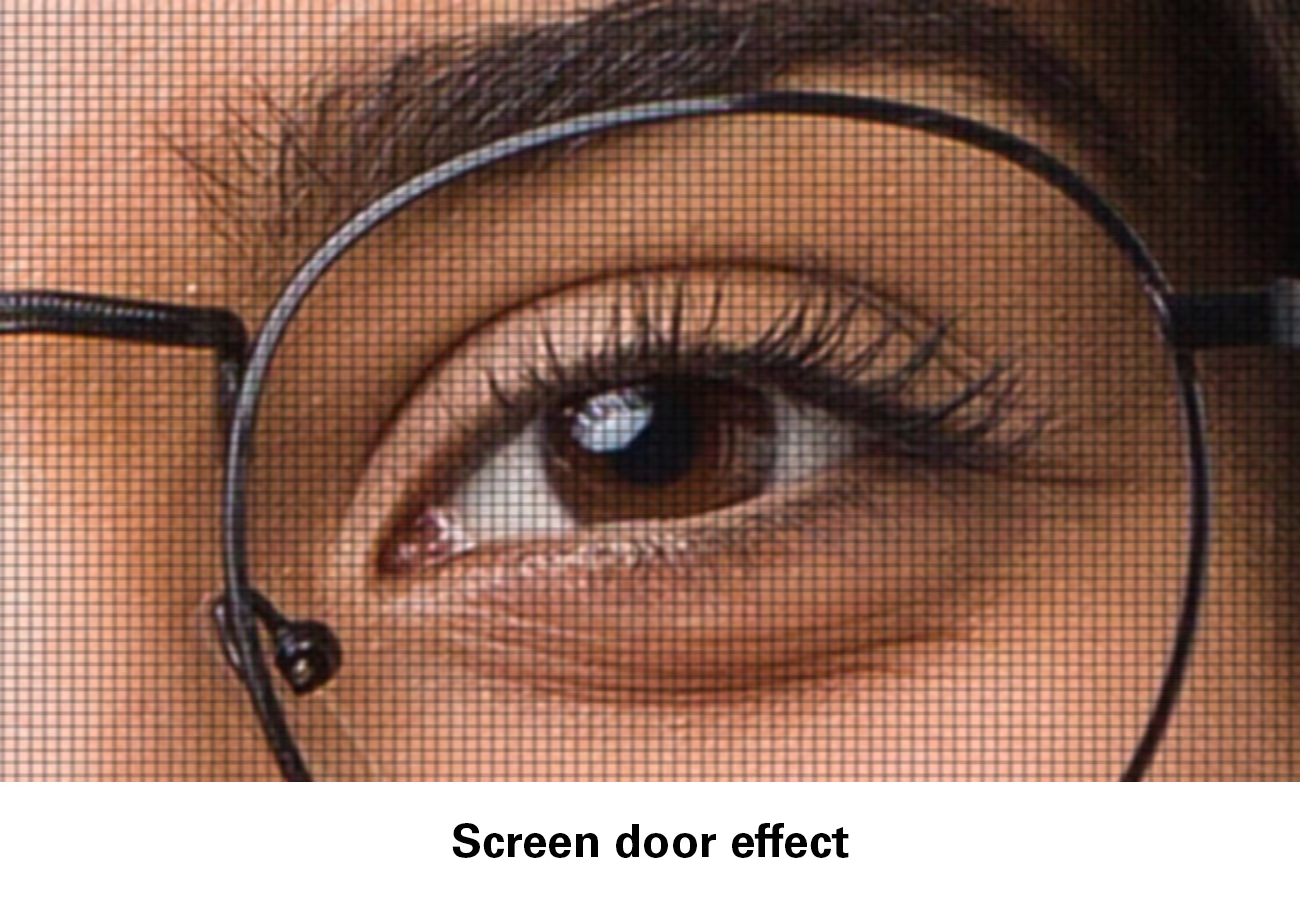

Eliminate the screen-door effect with 4x resolution
The screen-door effect refers to the visible dark grid between pixels that can reduce the smoothness and perceived quality of a projected image. Optotune’s XPR (eXpanded Pixel Resolution) technology addresses this by rapidly shifting the image in four half-pixel steps. By optically filling the gaps between pixels, XPR increases the apparent resolution by 4×, resulting in a smoother image, sharper details, and enhanced overall visual quality.
Beam shifting devices
Compact and precise pixel shifting with ultra-reliable bearingless design. XPRs are placed between sensor and imaging lens in camera systems, or DMD/LCD and projection lens in projection systems.
- Support
Not sure where to start?
Our team is here to answer your questions. Contact us and discover how we can support you.