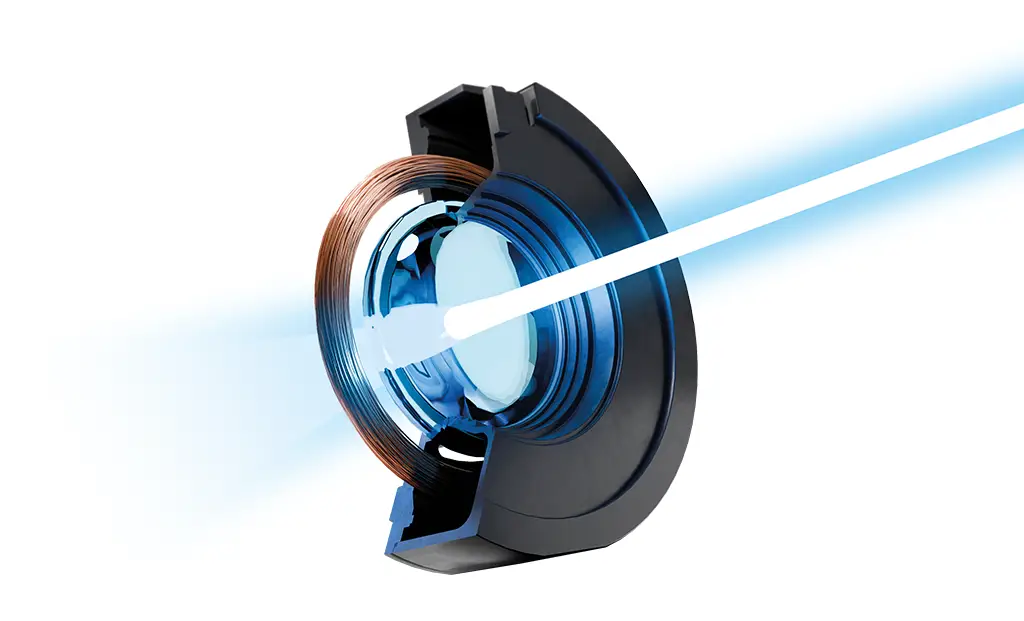
Tunable liquid lenses have moved well beyond research labs and niche optical setups. Today, they are found in machine vision systems inspecting products on high-speed production lines, microscopes scanning biological samples, medical devices requiring rapid focus adjustments, and metrology systems where precision is measured in micrometers.
The appeal is easy to understand. Rather than moving bulky mechanical assemblies to change focus, tunable liquid lenses adjust optical power electronically. This enables faster focus changes, simpler mechanical designs, and greater flexibility in applications where traditional autofocus mechanisms struggle to keep pace.
Yet selecting a tunable lens is rarely as straightforward as comparing a few specifications on a datasheet. Engineers evaluating solutions are often faced with a long list of parameters: aperture size, focal power range, response time, repeatability, optical quality, thermal stability, lifetime, and integration requirements. Some of these characteristics have an obvious impact on system performance. Others only reveal their importance once a prototype is built and tested.
The challenge is that no single parameter determines whether a lens is right for a particular application. A barcode reader designed to operate at high speed has very different priorities than a microscope or semiconductor inspection system. The most successful optical designs begin with an understanding of which performance criteria matter most for the intended use case.
This guide explores the key factors engineers should evaluate when selecting a tunable liquid lens and explains how these factors influence system performance in real-world applications.
Why Tunable Liquid Lenses Are Being Adopted Across Industries
Historically, focus adjustment meant moving glass. Whether in cameras, microscopes, or industrial optics, changing focus required translating one or more lens elements along the optical axis.
That approach remains effective, but it comes with limitations. Mechanical systems add complexity, increase wear over time, require additional space, and can constrain focusing speed.
Tunable liquid lenses approach the problem differently. By changing the shape of an optical surface through electrical control, they alter focal power without requiring traditional mechanical movement of lens groups. The result is a compact and highly responsive focusing mechanism that can be integrated into a wide variety of optical architectures. Electrically tunable liquid lenses are commonly used in machine vision, microscopy, life sciences, ophthalmology, barcode reading, and numerous industrial applications where fast and reliable focus control is required.
As imaging systems become increasingly automated, the demand for rapid and repeatable focus control continues to grow. However, determining whether a particular lens will meet performance requirements depends on much more than the ability to change focus quickly.
Why Aperture Size Often Determines More Than Engineers Expect
When comparing tunable lenses, many engineers naturally focus on focal power range first. In practice, aperture size often has a greater influence on the overall system architecture.
Aperture affects the amount of light reaching the sensor, compatibility with different sensor formats, achievable image quality, and potential optical configurations. A lens suitable for a compact sensor in a barcode scanner may not be appropriate for a larger machine vision camera or microscope objective.
Larger apertures generally provide greater flexibility when working with larger image circles and higher-resolution sensors. However, they also introduce additional considerations related to optical design, integration, response dynamics, and system dimensions.
For this reason, engineers should avoid asking simply, “What is the largest aperture available?” A more useful question is, “What aperture does the application actually require?” By defining sensor size, field of view, illumination conditions, and working distance requirements early in the design process, many unsuitable options can be eliminated before detailed evaluation even begins.
Looking Beyond Focal Range
Focal power range is often one of the first numbers engineers examine, and for good reason. It defines how much optical power can be varied and therefore influences the distances over which focus can be adjusted.
For applications such as autofocus inspection systems, variable-height objects, robotic vision, and microscopy, the available tuning range directly affects operating flexibility.
However, focal range should not be viewed in isolation.
Two lenses may offer similar tuning ranges while behaving very differently within a complete optical system. Factors such as aperture size, optical quality across the tuning range, and integration method can significantly influence the final system performance.
The most effective evaluation process focuses on application requirements first. Rather than maximizing every specification, engineers should determine the actual range of working distances the system must support and evaluate whether the lens can maintain the required image quality throughout that operating range.
Response Time Is Only Part of the Story
Speed is often one of the most attractive characteristics of tunable liquid lenses. Depending on lens size and configuration, response times can be on the order of only a few milliseconds, making them suitable for demanding automation and machine vision applications. Typical settling times across different lens platforms range from a few milliseconds to tens of milliseconds depending on aperture size and optical design.
Yet response time alone rarely tells the whole story.
In practical imaging systems, engineers should evaluate both rise time and settling time. A lens may begin changing optical power almost immediately, but image acquisition often cannot occur until the focus position has stabilized adequately.
Consider a high-throughput inspection system sorting products on a manufacturing line. The relevant question is not simply how quickly focus can change, but how quickly the entire imaging process can resume after a focus adjustment.
This distinction becomes particularly important in applications involving synchronized camera triggering, robotic motion, or autofocus routines where repeatable timing directly influences system throughput.
The Often-Overlooked Importance of Repeatability
If speed attracts attention during product selection, repeatability is often what determines long-term success.
Imagine a system that must inspect the same feature thousands of times per day. Each measurement requires returning to a specific focal position before an image is captured. Even very small deviations can influence measurement consistency over time.
For applications such as metrology, semiconductor inspection, microscopy, and other precision imaging systems, repeatability may be more important than raw focusing speed. The ability to return repeatedly to the same optical power can directly influence measurement accuracy, process consistency, and overall confidence in system results.
Published evaluations of tunable liquid lens performance have demonstrated both long-term stability and repeatability under demanding operating conditions, highlighting the importance of these characteristics in applications with extremely shallow depth of field.
When selecting a lens, engineers should consider not only how fast it moves, but how consistently it reaches its intended focal position over days, months, and years of operation.
Optical Quality Remains Fundamental
A lens can achieve impressive focusing speeds and wide tuning ranges, but if image quality suffers, those benefits quickly lose value.
Optical quality encompasses a range of characteristics including wavefront quality, aberrations, dispersion, transmission, and overall image fidelity across the tuning range.
The importance of these parameters varies significantly depending on the application. A barcode reader may tolerate optical imperfections that would be unacceptable in a metrology system or microscope. Likewise, multi-wavelength imaging applications often place greater emphasis on chromatic performance than conventional monochromatic systems.
Engineers should therefore evaluate whether optical performance remains consistent throughout the operating range rather than focusing solely on nominal specifications.
Ultimately, the purpose of the lens is not to change focus. It is to produce useful images. Any discussion of tunable lens performance should therefore remain grounded in the quality of the resulting optical system.
Reliability Matters More Than Speed in Long-Term Operation
One of the realities of industrial engineering is that the most impressive performance metrics rarely matter if the system cannot operate reliably over time.
Inspection systems may run around the clock. Medical devices are expected to perform consistently over extended service lifetimes. Scientific instruments often remain in operation for years.
For these reasons, reliability and operational lifetime deserve careful consideration during component selection.
Modern tunable liquid lens technologies have been designed for extremely high cycle counts and continuous operation. Published product information for industrial liquid lens platforms references lifetimes exceeding one billion cycles, reflecting the importance of durability in automation and imaging systems.
While lifetime figures provide a useful reference point, engineers should also think about maintenance requirements, expected duty cycles, environmental conditions, and the practical realities of long-term deployment.
Understanding the Operating Environment
Performance measured in a laboratory does not always translate directly to production environments.
Temperature fluctuations, vibration, mechanical shock, mounting orientation, and continuous operation can all affect system behaviour. These factors become increasingly important in industrial installations, outdoor systems, and applications requiring high measurement precision.
Temperature is particularly important because even small changes in optical power can influence focus position in systems with extremely shallow depth of field. As tolerances tighten, thermal stability becomes a more significant design consideration.
Evaluating a tunable lens therefore requires examining not only nominal performance specifications but also how the component behaves under realistic operating conditions.
The best-performing lens on paper is not always the best-performing lens inside an actual machine.
Don't Forget Integration
A technically excellent lens can still become a poor design choice if integration proves unnecessarily difficult.
Mechanical packaging, controller compatibility, software interfaces, communication protocols, calibration requirements, and synchronization with other system components all influence development effort.
Many engineers discover that integration complexity becomes a substantial part of total project cost. A solution that appears attractive based solely on optics may require significant development resources before it can be deployed successfully.
For this reason, evaluating a tunable liquid lens should include the broader ecosystem surrounding the component. Controllers, development tools, software support, and application expertise can all influence implementation speed and project risk. Controllers for tunable liquid lenses often provide features such as temperature compensation, response-time optimization, and industrial control interfaces that simplify deployment in production environments.
Selecting the Right Lens Begins With the Application
There is no universal definition of the ideal tunable liquid lens.
A system designed for barcode reading may prioritize speed and working-distance flexibility. A microscope may emphasize repeatability and image quality. A metrology platform may place greater value on stability than focusing speed. Medical applications frequently require a balance of compactness, reliability, and optical performance.
The most effective evaluation process starts by identifying application requirements and then working backwards toward the appropriate technology.
Rather than asking which tunable liquid lens is best, engineers should ask which characteristics are most important for their specific optical system.
Once that question is answered, the selection process becomes considerably clearer.
What Matters Most in Practice
Tunable liquid lenses have become an important tool for engineers designing modern optical systems. Their ability to provide fast, electronically controlled focus adjustment opens new possibilities in machine vision, microscopy, life sciences, medical devices, and industrial automation.
However, successful implementation depends on far more than a single specification.
Aperture size, focal power range, response time, repeatability, optical quality, reliability, environmental robustness, and integration requirements each play a role in determining overall system performance. The relative importance of these factors varies from one application to another.
Engineers who evaluate these criteria holistically are better positioned to select solutions that not only meet performance requirements on paper, but continue to deliver reliable results in the field.
As optical systems become increasingly automated and sophisticated, understanding these trade-offs will remain one of the most important steps in successful optical design.