Every optical system, from a smartphone camera to a high-end microscope, is built on a few fundamental principles. Light can be reflected, refracted, focused, or redirected, and optical engineers use these effects to create imaging systems, lasers, sensors, and countless other technologies.
While these principles have been known for centuries, modern adaptive optics have introduced a new capability: the ability to dynamically control how light behaves without relying on mechanical motion. Electrically tunable lenses, variable prisms, and fast steering mirrors make it possible to change focus and beam direction in real time, opening the door to faster, more compact, and more flexible optical systems.
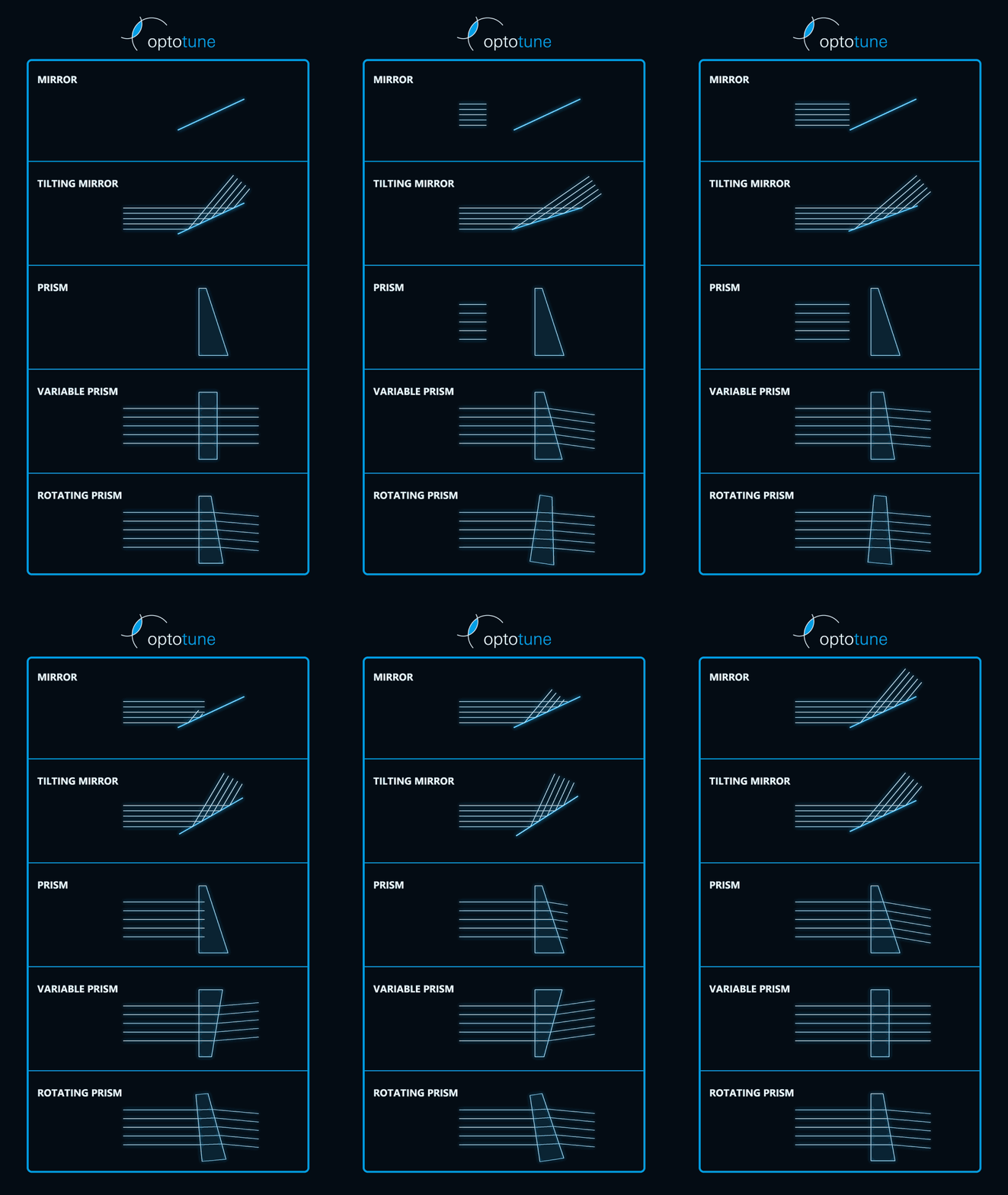
The animations throughout this article illustrate how different optical elements influence the propagation of light and how these same optical principles can be transformed into dynamic functions using adaptive optics.
Planar, Convex and Concave Optical Elements
The simplest optical element is a planar plate with two parallel surfaces. Although it does not alter the direction of a collimated beam, it can shift the beam sideways as it passes through the material. This effect becomes noticeable when viewing objects through a window at an angle, where objects may appear slightly displaced from their actual position.
Once the geometry of the optical surface changes, the behavior of the light changes as well. A convex lens bends incoming parallel rays towards a focal point, while a concave lens causes the rays to diverge. The stronger the curvature of the lens, the more strongly the light is refracted and the shorter the focal length becomes.
The relationship between focal length and optical power is defined as:
Optical Power = 1 / Focal Length
The unit of optical power is the diopter (dpt), which corresponds to inverse meters (1/m). A lens with a short focal length therefore has a high optical power, while a lens with a long focal length has a lower optical power.
Conventional glass lenses have a fixed geometry, meaning their optical power is fixed. Changing focus therefore requires moving one or more optical elements within the system.
Nature offers a different solution. The crystalline lens inside the human eye continuously changes its shape through a process known as accommodation, allowing us to focus on objects at different distances without physically moving the lens itself.
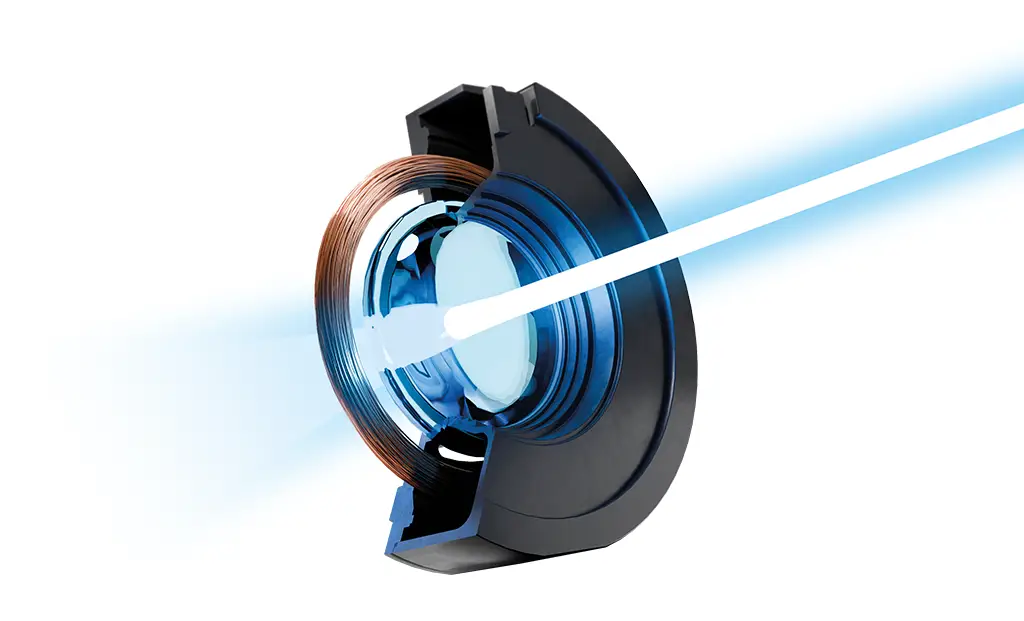
Optotune’s liquid lenses follow a similar principle. By electrically changing the shape of a liquid interface, the focal power of the lens can be adjusted continuously and at high speed. This enables dynamic focusing without mechanical translation, making the technology particularly attractive for machine vision, microscopy, medical imaging, and 3D imaging systems.
Electronic Focusing Without Mechanical Motion
The focusing animation demonstrates one of the most important functions in optics: bringing parallel light rays together at a common focal point.
In traditional optical systems, changing the focus position typically requires moving lenses along the optical axis. While effective, this approach introduces mechanical complexity, increases system size, and can limit response speed.
A focus tunable lens takes a different approach. Instead of moving a lens, the optical power of the lens itself changes electronically. As the curvature changes, the focal plane moves accordingly, allowing the system to rapidly refocus between objects at different distances.
This capability is particularly valuable in applications where speed matters, such as automated inspection systems, microscopy, or machine vision systems operating on moving objects.
Beam Shift: Moving Light Without Changing Its Direction
Not every optical function requires focusing. In many applications, the goal is simply to reposition a beam or image with high precision.
A planar optical element can introduce a lateral displacement of a transmitted beam while maintaining its original propagation direction. Although the effect appears simple, it forms the basis of several advanced optical functions where small positional adjustments are required.
Beam-shifting technologies are used in areas such as pixel shifting, image stabilization, and super-resolution imaging, where precise control over beam or image position directly influences system performance.
Mirrors and Beam Steering
Mirrors redirect light through reflection. According to the law of reflection, the angle of incidence is equal to the angle of reflection.
An important consequence of this principle is that a reflected beam moves by twice the angle through which the mirror itself is tilted. A mirror tilted by 10° therefore changes the beam direction by 20°.
This relationship makes mirrors highly efficient beam-steering devices. Relatively small mechanical movements can generate large optical deflection angles, which is why mirrors are widely used in applications that require rapid beam positioning.
Adaptive beam steering extends this concept further. Optotune’s MR series combines a mirror with voice-coil actuation and real-time optical feedback, enabling precise two-axis control of the reflected beam. Such systems are used in applications ranging from LiDAR and laser processing to optical inspection and field-of-view expansion.
Prisms and Refraction-Based Deflection
Unlike mirrors, prisms steer light through refraction rather than reflection.
When light enters a material with a different refractive index, its velocity changes, causing the light ray to bend according to Snell’s law. Because a prism consists of two non-parallel optical surfaces, the beam experiences a net angular deflection as it propagates through the element.
For small prism angles, the resulting beam deflection can be approximated as:
α ≈ (n − 1) · δ
where n is the refractive index of the prism material and δ is the prism angle.
Prisms are commonly used for beam steering, alignment, and image stabilization. Since the light remains transmitted through the optical element rather than reflected from it, prisms offer advantages in applications where preserving the optical path is important.
Tunable Prisms: Dynamic Beam Steering
A conventional prism has a fixed geometry and therefore a fixed deflection angle. A tunable prism introduces a degree of freedom by allowing the prism angle itself to be modified.
Optotune’s tunable prism technology achieves this by using a liquid-filled structure between two optical windows. Changing the relative tilt of these windows alters the effective prism angle and therefore the direction of the transmitted beam.
Unlike a fixed prism, a tunable prism allows both the magnitude and the direction of the optical deflection to be adjusted dynamically. This capability is particularly useful in image stabilization systems, where small and continuous corrections are required to compensate for motion.
One example is optical image stabilization in binoculars. Two tunable prisms can actively compensate for hand-induced movement, helping maintain a stable image even at high magnifications.
An additional advantage of prism-based steering is that the deflection angle is largely insensitive to small mounting errors, making prism systems inherently robust in practical implementations.
From Optical Principles to Adaptive Optics
The optical principles discussed in this article are nothing new. Reflection, refraction, focusing, and beam steering have formed the foundation of optical design for centuries. Traditionally, however, these functions were implemented using fixed optical components. A lens had a fixed focal length, a prism produced a fixed deflection angle, and steering a mirror required mechanical movement.
What Optotune does is take these established optical principles and make them dynamic.
Our focus tunable liquid lenses allow optical power to be adjusted electronically, enabling systems to change focus without moving traditional lens groups. Our tunable prisms make it possible to control the direction of transmitted light in real time, supporting applications such as optical image stabilization and beam alignment. Our fast steering mirrors add high-speed, precise beam control for applications including LiDAR, laser processing, optical inspection, and advanced imaging systems.
By replacing fixed optical functions with electronically controllable ones, adaptive optics give system designers new ways to improve speed, reduce mechanical complexity, and create more compact optical architectures.
Whether the goal is focusing on objects at different distances, stabilizing an image, or steering a laser beam with high precision, the underlying physics remain the same. The difference is that adaptive optics allow these functions to happen dynamically, continuously, and at high speed.
At Optotune, this transformation from fixed optics to adaptive optics is at the core of what we do. By combining established optical principles with innovative actuator and control technologies, we help engineers build optical systems that are faster, more flexible, and capable of adapting to changing conditions in real time.